

Let’s be completely honest for a second.
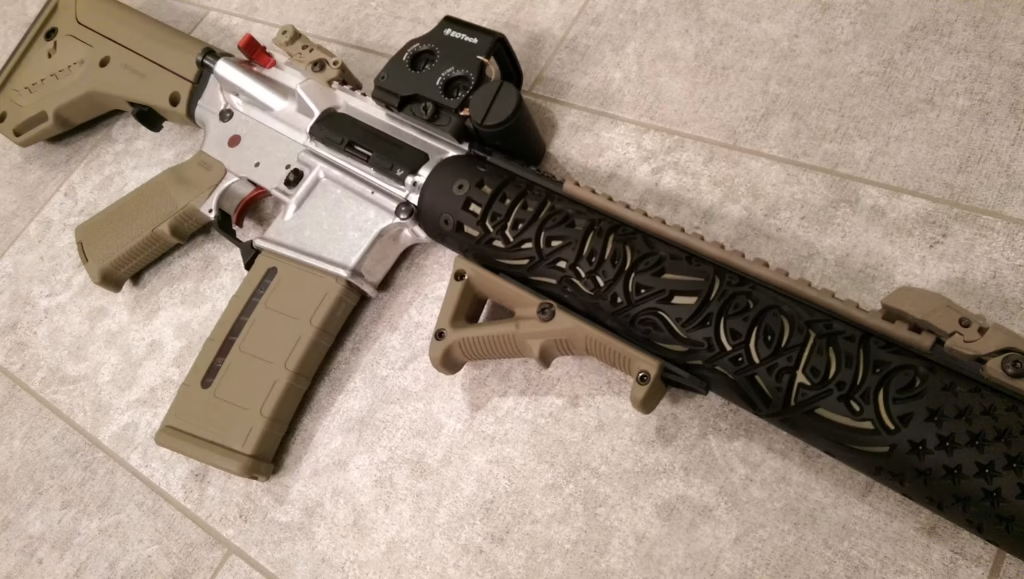
When most builders sit down to plan out a custom scratch-build upper assembly, they spend all their time staring at aesthetic components (best handguards for ghost guns). They look at custom slide weights, skeletonized receivers, or aggressive grip texturing. When they finally evaluate a handguard, they make the selection based on a single superficial metric: “Does this make my build look like a futuristic space weapon?”
Aesthetics matter, but there is a massive, painful difference between an upper receiver that looks excellent on a workshop table and one that you can actually run through heavy courses of fire without burning your support hand to a crisp.
As a professional gun vendor operating Ghost Guns Official, I see this scenario play out constantly on our workshop benches. A builder buys the slimmest, cheapest, most enclosed handguard they can find because it looks sleek. They assemble the upper receiver, mount their optics, head out to the range, and load up three fresh magazines.
By the middle of the second magazine, thermodynamics catches up with them. The rail becomes so hot that rising heat waves distort their sight picture. By the third magazine, the aluminum alloy has absorbed so much thermal energy that holding the front of the weapon without heavy, insulated gloves is impossible.
If you want a custom rifle or pistol build that stays comfortable to shoot, maintains structural reliability, and preserves its point of impact (POI) through intense training sessions, you must look past surface cosmetics. You need to approach selecting the best handguards for ghost guns with the exact same engineering discipline a precision gunsmith uses to manage structural airflow and heat transfer.
1. The Physics of Bore Heat: Conduction, Convection, and Radiation
Every time a cartridge detonates inside your chamber, propellant gases instantly heat up to over 3,000 degrees Fahrenheit and create pressures scaling past 50,000 psi. A massive percentage of this sudden thermal energy is instantly absorbed directly into the steel walls of your barrel.
During rapid-fire strings, that heat builds up exponentially. To prevent catastrophic thermal transfer to your hands, you must understand the three distinct physical pathways your barrel uses to naturally shed this intense thermal load:
                  [HANDGUARD UPPER RAIL]
   +--------------------------------------------+
   |                                            |
   |   ^ Convection (Rising Hot Air Chimney)    |
   |   |                                            |
   +---|----------------------------------------+
       |   <-- Radiation (Infrared Heat Waves)
  +----+---------------------------------------+
  |              HOT BARREL BORE               |
  +----+---------------------------------------+
   |   |
   |   v Conduction (Direct Heat via Barrel Nut)
   +--------------------------------------------+
   |                                            |
   |   [HANDGUARD LOWER RAIL]                   |
   +--------------------------------------------+
- Conduction (Physical Contact): Thermal energy travels directly down the physical structure of the metal, transferring from the barrel extension into the barrel nut, and then straight into the mechanical mounting interface of your handguard.
- Convection (Air Movement): The hot air immediately surrounding the outside surface of the barrel rises, creating a natural chimney effect. Cooler, ambient air must flow in from the bottom of the handguard to replace it and pull the heat away from the barrel walls.
- Radiation (Infrared Energy): The hot steel radiates infrared heat energy outward through space into the surrounding environment.
A poorly designed, overly enclosed handguard acts like an insulating thermal blanket. It traps radiant infrared waves and blocks convective airflow, creating a localized greenhouse effect around your gas block and barrel profile. This thermal containment accelerates throat erosion inside your bore, permanently short-changing the accurate lifespan of your barrel while turning your handguard into an unusable branding iron.

2. Advanced Material Science: Aluminum Alloys vs. Carbon Fiber
Different materials absorb, conduct, and dissipate thermal energy at radically different rates. When you are looking through our store trying to find the best handguards for ghost guns, your build goals must align with the correct material composition.
6061-T6 Aluminum: The Structural Workhorse
The vast majority of high-quality free-float handguards on the market are machined from extruded 6061-T6 aluminum alloy. This specific blend offers an exceptional balance of structural tensile strength, lightweight maneuverability, and high thermal conductivity.
Because aluminum conducts heat incredibly well, a 6061-T6 handguard pulls thermal energy away from the barrel nut junction quickly and spreads it across the entire physical surface area of the rail structure. This allows the handguard to act like a giant radiator, cooling the internal system down rapidly once you stop shooting. The trade-off is direct: because it conducts heat so efficiently, the handguard itself will feel hot to the touch very quickly during continuous firing strings. Read about the material properties and conductivity of 6061-T6 alloys.
7075-T6 Aluminum: The High-Rigidity Elite Alloy
If you are looking for an upgraded aluminum variant, look for handguards machined from 7075-T6 aluminum. This alloy is significantly stronger and harder than 6061, nearly doubling its yield strength.
Because the metal is inherently tougher, manufacturers can machine the handguard walls down to a much thinner profile without sacrificing structural rigidity under hard use. A thinner wall means less overall weight on the front end of your build and less raw thermal mass available to trap residual heat. However, 7075-T6 has slightly lower thermal conductivity than 6061-T6, meaning it takes a bit longer for heat to migrate into the handguard body, but it also takes slightly longer to cool back down once fully heat-soaked.
Advanced Carbon Fiber Composites: The Ultimate Insulator
If your primary objective is creating a high-volume firing rig that completely protects your support hand from thermal transfer, advanced carbon fiber handguards are the gold standard.
Unlike aluminum alloys, carbon fiber has incredibly low thermal conductivity across its structural layers. It acts as a natural heat shield rather than a heat sink. You can get a rifle barrel blistering hot underneath a carbon fiber rail, and the exterior surface of the handguard will remain totally comfortable to hold with a bare hand. Furthermore, carbon fiber offers an unmatched strength-to-weight ratio, giving you a feather-light front end. The only drawback is that because it acts as an insulator, it keeps the heat contained inside the handguard cavity longer, meaning your barrel will take more time to naturally cool down between strings of fire.
3. Ventilation Architecture: Airflow Dynamics and Clearance Profiles
Once you choose your material, you must analyze the physical shape, cutout architecture, and spatial clearance of the handguard shell. This is where thermal management meets mechanical mounting functionality.
       [SLIM LINE PROFILE]                     [WIDE BORE PROFILE]
    +-----------------------+              +-----------------------+
    |     +-----------+     |              |     +-----------+     |
    |     |  BARREL   |     |              |     |  BARREL   |     |
    |     +-----------+     |              |     +-----------+     |
    +-----------------------+              |                       |
     (Restricted Air Vol.)                 +-----------------------+
     (Accelerated Heating)                  (Massive Air Volume)
                                            (Convective Chimney)
Internal Diameter (ID) Clearance
The internal diameter is the measurement across the inside cavity of the handguard rail, and it dictates the air-buffer capability of your system.
- Slim-Line Rails (1.3 inches or less): These look sleek and allow for a highly ergonomic, comfortable C-clamp grip around the weapon. However, because the space between the barrel and the inside rail wall is so compressed, the volume of ambient air inside is microscopic. The air superheats almost instantly, leading to rapid, unavoidable thermal transfer to your hands.
- Wide-Bore Rails (1.5 inches to 1.7 inches or greater): These provide a substantial cushion of air surrounding the barrel and gas block assembly. This larger air volume slows down radiant heat transfer and creates an optimized channel for convective airflow to travel up and away from the core components.
M-LOK Modularity vs. Old-School Quad Rails
The mounting interface system you select alters how your upper assembly breathes under stress.
+--------------------------------------------------------------------------+
|                     HANDGUARD VENTILATION MATRIX                         |
+--------------------------------------------------------------------------+
| ATTACHMENT SYSTEM  | THERMAL PROFILE          | VENTILATION EFFICIENCY   |
+--------------------+--------------------------+--------------------------+
| Picatinny Quad Rail| Acts as a massive aluminum| Low airflow; traps air   |
|                    | heat sink; heavy mass.   | inside the solid corners.|
+--------------------+--------------------------+--------------------------+
| M-LOK Free-Float   | Slim profile with open   | High convective chimney  |
|                    | modular slots.           | effect; sheds heat fast. |
+--------------------+--------------------------+--------------------------+
- Picatinny Quad Rails: These are legendary for their bulletproof durability and rugged looks. Because they feature four solid rows of heavy machined rails, they have massive aluminum mass. This allows them to absorb a lot of initial heat before transferring it to your hands. However, they lack open structural surface area, meaning they trap hot ambient air inside the barrel channel like a furnace.
- Modern M-LOK Systems: M-LOK is the undisputed standard when choosing components within our AR-15 handguards product category. The elongated attachment slots cut along the 3, 6, 9, and 12 o’clock positions aren’t just for mounting flashlights, handstops, or vertical grips. They double as highly efficient thermal ventilation windows. As hot air rises off your barrel, the top and side M-LOK slots act like exhaust chimneys, pulling cool air in through the bottom slots and venting heat out into the atmosphere continuously.
You can read more about MIL-STD-1913 Picatinny and modular rail specifications.

4. The Critical Interface: Barrel Nut Engineering and Heat Sinks
Heat moves along the path of least resistance through solid metal contact. In any free-float design, the only physical point where your handguard touches your loaded upper receiver assembly is at the barrel nut. This makes the barrel nut the literal ground zero for conductive heat transfer.
+-------------------+        +--------------------+        +--------------------+
|   Upper Receiver  | =====> | Precision Steel /  | =====> | Aluminum Handguard |
|   Chamber Area    | Conduction | Aluminum Barrel Nut| Conduction | Body & Pic Rails   |
+-------------------+        +--------------------+        +--------------------+
                             [Integrated Cooling Fins]
                             (Intercepts heat here)
When you are grading options to assemble the best handguards for ghost guns, you must inspect the engineering properties of the barrel nut system included in the package:
Heavy-Duty Steel Barrel Nuts
Many budget options utilize basic, heavy steel barrel nuts. Steel is highly rigid and offers structural peace of mind, but it acts like a giant thermal battery. It absorbs heat slowly from the chamber extension, but once it gets saturated with energy, it holds onto that heat for a very long time, bleeding thermal energy steadily into the aluminum handguard body long after you’ve stopped shooting.
Enhanced Aluminum and Finned Barrel Nuts
Premium, high-tier handguard systems feature extended aluminum barrel nuts or advanced designs with machined cooling fins. Aluminum transfers thermal energy out into the air far faster than steel. By adding structural cooling cuts or fins directly onto the barrel nut profile, the manufacturer creates an integrated internal heat sink. This heat sink radiates thermal energy away into the air venting through your rear M-LOK slots before it ever gets the chance to conduct down into the front section of the handguard where your hands are placed.
Anti-Rotation Tabs and Thermal Expansion Alignment
When metal gets hot, it expands. If a handguard is built with cheap, sloppy manufacturing tolerances, intense thermal cycling can cause the metal to stretch and twist slightly out of alignment.
High-end handguards feature integrated anti-rotation tabs that mechanically lock around the upper receiver walls, combined with robust clamping systems that ensure even under extreme thermal expansion, your top Picatinny rail stays completely straight and aligned with your upper receiver, preserving the zero of your iron sights or laser aiming modules.
5. Aligning Specifications with Operational Intent
Just like picking a car tire, there is no single “perfect” option that does everything. You must match the physical engineering profile of your handguard directly to the specific blueprint and mission role of your custom build project.
The Suppressed “Oven” Configuration
- The Challenge: Running a silencer on a short-barreled platform creates a massive buildup of backpressure and extreme heat. If you choose a handguard that is long enough to cover or “tuck” the suppressor inside the rail, you are placing an incredibly hot object directly inside your handguard cavity.
- Our Selection Guidance: You absolutely require a wide-bore handguard with a minimum internal diameter of 1.55 inches to 1.7 inches. Look for aggressively skeletonized M-LOK variants that offer maximum open air real estate to prevent thermal containment, or pivot entirely to a heavy-duty carbon fiber profile that keeps the exterior surface safe to hold.
The Hard-Use Defensive Duty Build
- The Challenge: You need a balanced system that can take a beating, survive being dropped on concrete, support laser aiming systems without shifting zero, and keep your support hand safe during long training courses.
- Our Selection Guidance: Go with a rigid, free-floating 6061-T6 or 7075-T6 aluminum M-LOK handguard featuring an extended aluminum barrel nut. Look for a slim-line profile for ultimate ergonomic C-clamp weapon control, but ensure the rail has abundant ventilation cutouts along the non-mounting surfaces to keep the weight down and allow convective cooling to process efficiently.
The Precision Long-Range System
- The Challenge: Thermal expansion cannot be allowed to touch or exert pressure on the barrel profile. You need absolute mechanical isolation to achieve consistent sub-MOA groupings.
- Our Selection Guidance: Choose a true free-float handguard system that interfaces exclusively with a heavy-duty, long barrel nut. The handguard must have zero physical contact with the barrel or gas block at any point along its length. Prioritize a system with a full-length top Picatinny rail and reinforced locking mechanisms to provide a completely stable platform for mounting precision bipods and high-magnification optics.
Frequently Asked Questions
Q: What is the best handguard material for extreme barrel heat?
A: Advanced carbon fiber handguards provide the best thermal insulation to protect your hands, while premium 6061-T6 or 7075-T6 aluminum alloys offer the fastest heat dissipation. Carbon fiber acts as a natural heat shield, while aluminum free-float rails act as an efficient radiator to cool your upper assembly quickly after heavy strings of fire.
Q: How does internal diameter clearance affect handguard temperature?
A: Slim-line rails (1.3 inches or less) trap a tiny air volume that superheats instantly, causing rapid thermal transfer. Selecting wide-bore handguards (1.5 inches to 1.7 inches) provides a massive convective cushion that slows down radiant heat and optimizes cooling airflow around your barrel and low-profile gas block.
Q: Why are M-LOK handguards better for cooling than quad rails?
A: Modern M-LOK slots double as highly efficient convective cooling chimneys, whereas solid Picatinny quad rails trap hot air inside the barrel channel. The open attachment windows on an M-LOK system allow rising hot air to vent out naturally through the top and sides while drawing cooler ambient air in through the bottom.
Q: How does the barrel nut impact heat transfer to the handguard?
A: The barrel nut is the ground zero for conductive heat transfer because it is the sole physical contact point between the rail and the receiver. Standard steel nuts retain heat and bleed it into your grip profile, while an enhanced aluminum barrel nut featuring integrated cooling fins radiates thermal energy away before it can reach your handguard.
Conclusion: Build on a Cool Foundation
Screwing together your own custom platform from raw components is one of the most rewarding experiences a firearm owner can have. It forces you to master the delicate mechanical relationships of pressure, timing, and structural materials.
But a true gunsmith knows that real performance isn’t just skin deep. Don’t let your range days get cut short or your accuracy drift away because you choked your barrel’s thermal ventilation with a cheap, poorly designed handguard sleeve.
Take control of your project’s engineering, respect the laws of thermodynamics, and build it right the first time. Head over to our dedicated handguards and rails collection at Ghost Guns Official today, pick out the exact length and mounting architecture your project demands, and give your custom build the cooling foundation it needs to perform flawlessly under pressure.
Next Post: The 2026 Masterclass to Selecting Ghost Gun Barrels Like a Precision Gunsmith
